Choosing cosmetic packaging is not simply a matter of selecting an attractive bottle. The package must work with the formula, provide an appropriate dosage, protect the product during transportation, and create a convenient user experience.
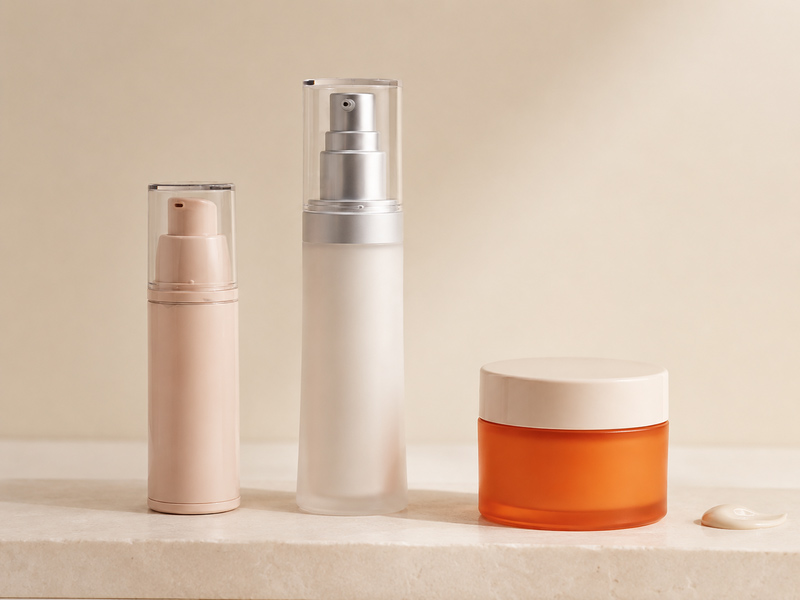
An airless bottle, lotion pump bottle, and cosmetic jar can all be used for skincare products, but they have different dispensing structures. A package that works well for a light facial serum may not be suitable for a rich body butter.
For overseas buyers, wholesalers, and beauty brands, understanding these differences can reduce development delays and prevent expensive packaging changes after production has started.
1. How the Three Packaging Formats Work
An airless bottle normally uses a mechanical pump together with a moving piston or collapsible inner container. When the pump is pressed, the product is dispensed and the piston moves upward, or the inner container contracts.
Many airless systems do not use a long dip tube. This structure is widely used for facial serums, treatment lotions, eye creams, foundations, and premium skincare products.
A lotion pump bottle uses a pump and dip tube to draw the product from the bottom of the container. It is commonly used for body lotion, shampoo, conditioner, liquid soap, and other medium-viscosity formulas.
A cosmetic jar has a wide opening that allows consumers to access the product directly. It is often selected for thick creams, balms, masks, scrubs, and semi-solid formulas.
| Packaging format | Dispensing method | Common applications | Typical capacity |
|---|---|---|---|
| Airless bottle | Pump with piston or inner container | Serum, treatment lotion, eye cream and foundation | 15–150 ml |
| Lotion pump bottle | Pump with dip tube | Lotion, shampoo, conditioner and cleanser | 100–1,000 ml |
| Cosmetic jar | Direct access or top pump | Cream, balm, mask, scrub and body butter | 5–500 ml |
“Airless” does not mean that the package contains an absolute vacuum or guarantees unlimited formula protection. Performance depends on the formula, pump design, filling process, sealing structure, and manufacturing quality.
2. Match Packaging to Formula Viscosity
Viscosity is one of the most important packaging selection factors. Low-viscosity formulas flow easily, while high-viscosity formulas require a wider product pathway, stronger pump system, or open jar.
The following table provides a general starting point:
| Formula type | Typical viscosity | Recommended format | Key consideration |
|---|---|---|---|
| Facial serum | Low to medium | Airless or treatment pump | Small, controlled dosage |
| Facial lotion | Medium | Airless or lotion pump | Pump output and evacuation |
| Body lotion | Medium | Lotion pump bottle | Higher output and larger capacity |
| Rich face cream | Medium to high | Airless jar or cosmetic jar | Product pathway and user access |
| Body butter | High | Cosmetic jar | Wide opening for easy removal |
| Cleansing balm | Semi-solid | Cosmetic jar | Sealing and formula compatibility |
| Shampoo | Low to medium | Lotion pump or disc-top bottle | Frequent use and flow rate |
| Hair mask | High | Cosmetic jar or high-output pump | Wide pathway may be required |
| Facial mist | Low | Fine mist spray bottle | Spray pattern and particle size |
| Scrub with particles | Medium to high | Jar or suitable wide-path dispenser | Particles may block small pumps |
This guide should not replace testing. Two formulas described as “medium viscosity” may perform very differently because of oils, powders, polymers, particles, or temperature changes.
3. Compare Performance, Cost, and User Experience
An airless bottle is often selected when controlled dispensing and treatment-oriented positioning are important. It can provide a clean user experience because consumers do not repeatedly touch the formula.
A lotion pump bottle is usually more economical, especially for larger capacities. It is familiar to consumers and suitable for many personal care applications.
A cosmetic jar provides easy access to high-viscosity formulas. It can also create a strong premium appearance, particularly when using double-wall, thick-wall, refillable, or airless jar structures.
| Selection factor | Airless bottle | Lotion pump bottle | Cosmetic jar |
|---|---|---|---|
| Controlled dosage | Excellent | Good | Limited with standard jar |
| Suitable for thick formulas | Depends on pump | Limited to medium viscosity | Excellent |
| Large-capacity suitability | Moderate | Excellent | Good |
| Product contact by fingers | Low | Low | Possible |
| Product evacuation | Usually good when validated | Depends on tube and bottle | Consumer can access product directly |
| Packaging cost | Medium to high | Low to medium | Low to high |
| Premium appearance | Excellent | Depends on design | Excellent |
| Filling complexity | Medium | Low to medium | Low |
| Travel suitability | Good with cap or lock | Requires secure locking | Requires reliable sealing |
Packaging should also be matched to how the consumer uses the product. A face serum may require 0.20 ml per stroke, while a body lotion may require 1.50 ml or more.
4. Evaluate the Complete Dispensing System
A pump should not be selected only because it fits the bottle neck. The bottle, pump, gasket, spring, dip tube, actuator, and formula must perform as one system.
When reviewing an airless or lotion pump package, confirm:
- Pump output per stroke
- Priming performance
- Number of strokes required for first use
- Product pathway diameter
- Dip-tube length, if applicable
- Locking mechanism
- Actuator size and pressing force
- Product evacuation rate
- Leakage resistance
- Compatibility of internal components
For lotion pump bottles, dip-tube length is important. A tube that is too short may leave too much formula inside, while a tube that is too long may bend incorrectly or block the pump inlet.
For airless bottles, the filling level, piston position, pump sealing, and formula viscosity can affect priming and evacuation.
For cosmetic jars, buyers should evaluate the jar neck, thread, cap, liner, inner disc, and sealing surface. A package that performs well with a dense balm may not provide the same leakage resistance with a fluid gel.
5. Packaging Compatibility and Performance Checklist
Physical samples should be tested with the actual bulk formula before mass production.
Formula Information
- Formula type and application
- Approximate viscosity
- Oil, alcohol, acid, or solvent content
- Presence of particles or powders
- Sensitivity to air, light, or moisture
- Expected storage temperature
Dispensing Tests
- Pump can be primed correctly
- Output per stroke is consistent
- Formula does not block the pathway
- Actuator returns after each use
- Package works at different product levels
- Acceptable product remains after final use
Leakage and Transportation Tests
- Upright leakage test
- Side-position leakage test
- Inverted leakage test
- High- and low-temperature test
- Drop test
- Transportation simulation
- Cap or pump lock remains secure
Appearance and Decoration Tests
- Color remains stable
- Bottle does not swell or deform
- Formula does not discolor the package
- Printing and coating remain attached
- Components assemble correctly
- Surface is free from visible damage
Several samples should be tested rather than relying on one unit. Testing should also continue for an appropriate period because some compatibility problems do not appear immediately.
6. Quick Packaging Selection Checklist
Before requesting a quotation, send the supplier the following information:
- Product application
- Formula viscosity
- Required capacity
- Preferred package format
- Target output per stroke
- Preferred bottle material
- Neck or closure specification
- Target market
- Decoration requirements
- Estimated order quantity
- Filling location
- Planned launch date
If the formula has not been finalized, request several packaging options and evaluate them during formula development. Packaging and formula development should progress together rather than as separate projects.
Conclusion
Airless bottles, lotion pump bottles, and cosmetic jars provide different dispensing experiences.
An airless bottle is often suitable for controlled-dose skincare and treatment products. A lotion pump bottle offers a practical and economical solution for body care, haircare, and other medium-viscosity formulas. A cosmetic jar provides convenient access to creams, balms, masks, and high-viscosity products.
No format is universally better than another. The best packaging is the one that provides stable compatibility, reliable dispensing, appropriate protection, and a positive user experience.
By sharing accurate formula information and completing proper compatibility and performance testing, overseas buyers can reduce sourcing risks and move into mass production with greater confidence.